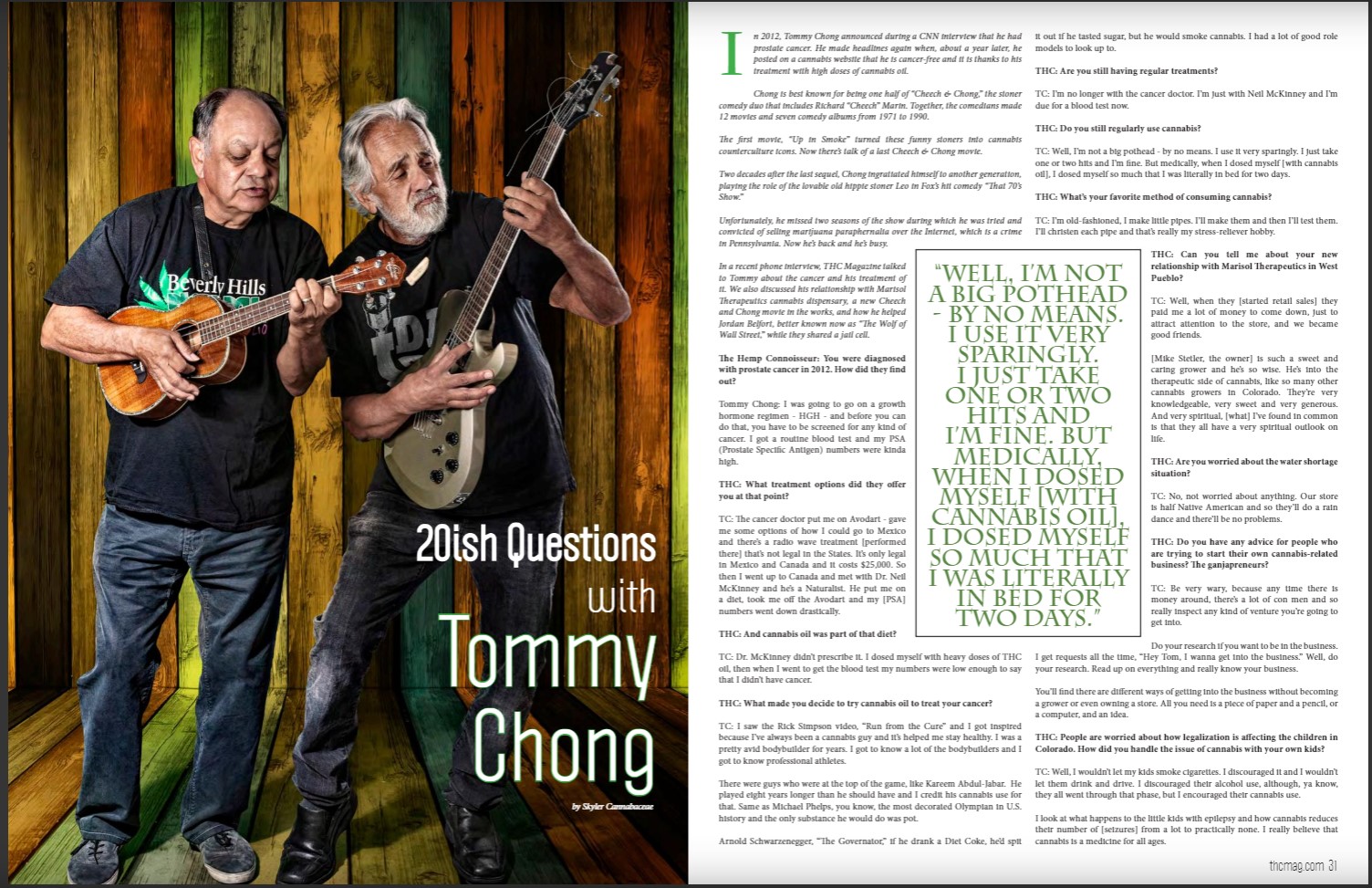
20ish Questions with Tommy Chong

In 2012, Tommy Chong announced during a CNN interview that he had prostate cancer. He made headlines again when, about a year later, he posted on a cannabis website that he is cancer-free and it is thanks to his treatment with high doses of cannabis oil.

Chong is best known for being one half of “Cheech & Chong,” the stoner comedy duo that includes Richard “Cheech” Marin. Together, the comedians made 12 movies and seven comedy albums from 1971 to 1990.

The first movie, “Up in Smoke” turned these funny stoners into cannabis counterculture icons. Now there’s talk of a last Cheech & Chong movie. Two decades after the last sequel, Chong ingratiated himself to another generation, playing the role of the lovable old hippie stoner Leo in Fox’s hit comedy “That 70’s Show.”

Unfortunately, he missed two seasons of the show during which he was tried and convicted of selling marijuana paraphernalia over the Internet, which is a crime in Pennsylvania. Now he’s back and he’s busy.

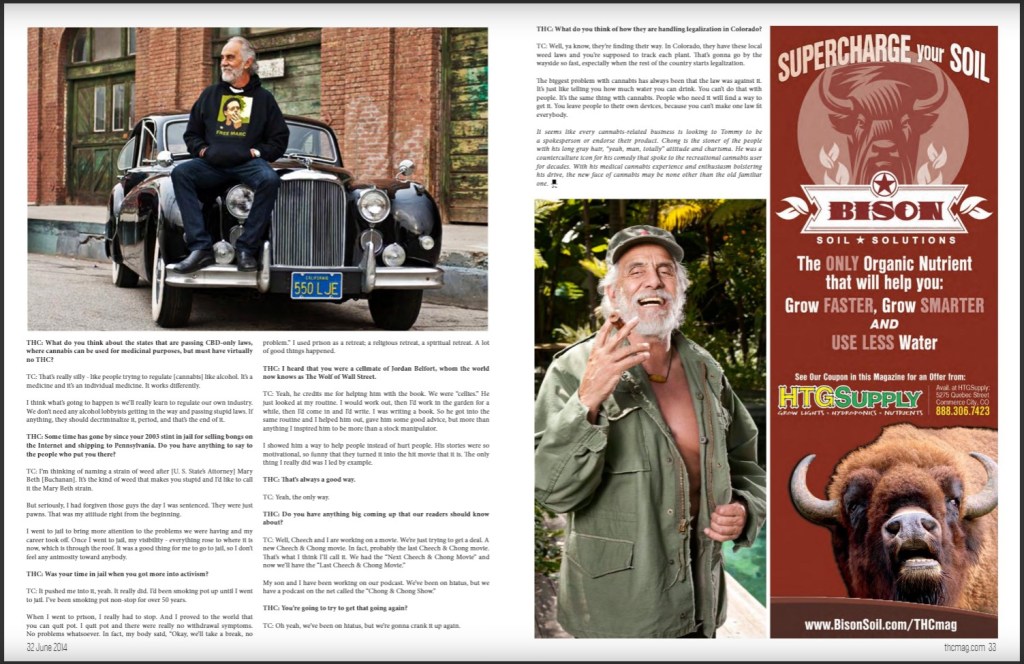
In a recent phone interview, THC Magazine talked to Tommy about the cancer and his treatment of it. We also discussed his relationship with Marisol Therapeutics cannabis dispensary, a new Cheech and Chong movie in the works, and how he helped Jordan Belfort, better known now as “The Wolf of Wall Street,” while they shared a jail cell.
 
Originally written for and published by The Hemp Connoisseur Magazine as Skyler Cannabaceae.
The Hemp Connoisseur, June 2014 – Issue #18

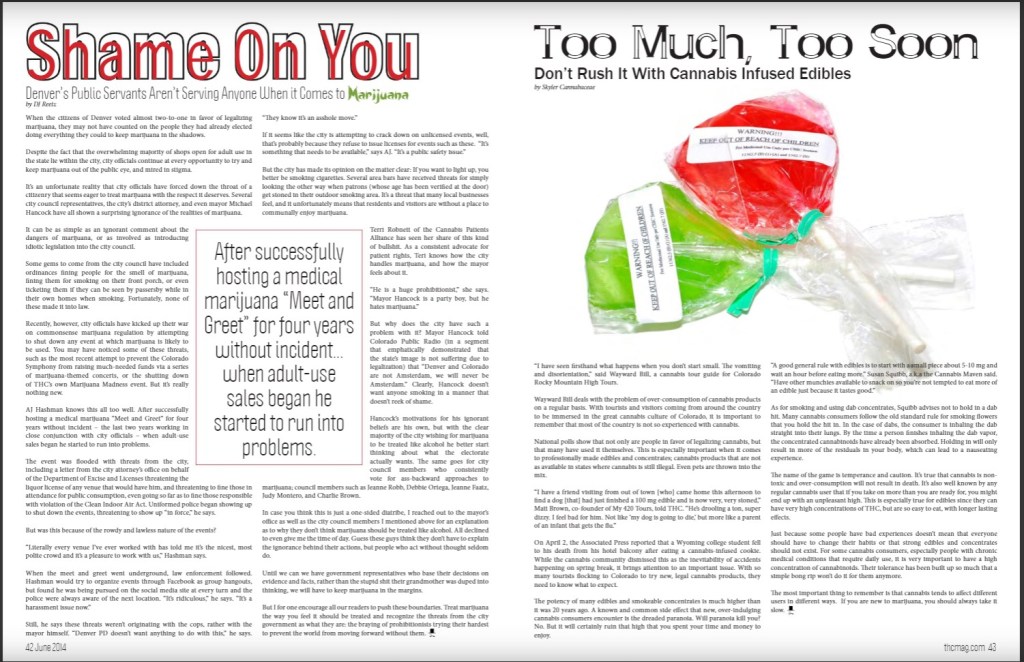
Too Much, Too Soon: Don’t Rush It With Cannabis Infused Edibles


“I have seen firsthand what happens when you don’t start small. The vomiting and disorientation,” said Wayward Bill, a cannabis tour guide for Colorado Rocky Mountain High Tours.

Wayward Bill deals with the problem of over-consumption of cannabis products on a regular basis. With tourists and visitors coming from around the country to be immersed in the great cannabis culture of Colorado, it is important to remember that most of the country is not so experienced with cannabis.

National polls show that not only are people in favor of legalizing cannabis, but that many have used it themselves. This is especially important when it comes to professionally made edibles and concentrates; cannabis products that are not as available in states where cannabis is still illegal. Even pets are thrown into the mix.

“I have a friend visiting from out of town [who] came home this afternoon to find a dog [that] had just finished a 100 mg edible and is now very, very stoned,” Matt Brown, co-founder of My 420 Tours, told THC. “He’s drooling a ton, super dizzy. I feel bad for him. Not like ‘my dog is going to die,’ but more like a parent of an infant that gets the flu.”

This article was originally published by The Hemp Connoisseur Magazine as Skyler Cannabaceae.
The Hemp Connoisseur, June 2014 – Issue #18

A Sour Note: Denver Challenges CSO Cannabis Series

You’ve just consumed a cannabis treat, smoked a bowl, or did a dab. The orchestra revs up and starts playing a beautiful piece to take you away to a world of music, far from your worries and cares.

You immerse yourself in the music with the assistance of cannabis and the orchestra gains another patron. That was the idea when the Colorado Symphony Orchestra collaborated with the cannabis industry.

Cannabis users know that music sounds better with a little THC. The CSO used this knowledge to make its first foray into the world of cannabis with their unique “bring-your-own-cannabis” series, “Classically Cannabis: The High Note Series.” Its first event was on March 23 at the Space Gallery in Denver, but it almost didn’t happen.

The city has been shutting down events through intimidation since retail cannabis was legalized, citing that the law does not allow “public consumption.” What public consumption actually means is a hot topic of debate between the city and cannabis advocates. Since the warning letters started going out, activists, business owners and cannabis consumers have been trying to discern what the city considers public.

The City of Denver hand-delivered a warning letter to the orchestra on May 8. The letter said that if the concert series went forward, participating business owners and event organizers will be legally responsible for any violations. The letter had a warning for patrons as well.

Originally written for and published by The Hemp Connoisseur Magazine as Skyler Cannabaceae.
The Hemp Connoisseur, June 2014 – Issue #18

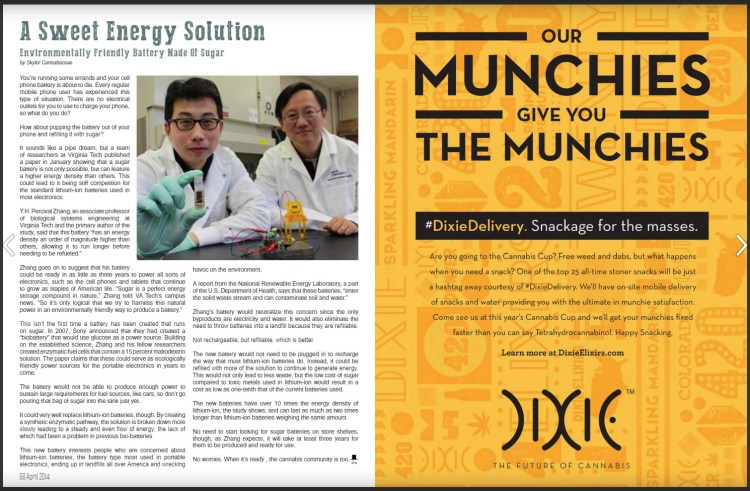
A Sweet Energy Solution: Environmentally Friendly Battery Made Of Sugar

You’re running some errands and your cell phone battery is about to die. Every regular mobile phone user has experienced this type of situation. There are no electrical outlets for you to use to charge your phone, so what do you do?

How about popping the battery out of your phone and refilling it with sugar?

It sounds like a pipe dream, but a team of researchers at Virginia Tech published a paper in January showing that a sugar battery is not only possible, but can feature a higher energy density than others. This could lead to it being stiff competition for the standard lithium-ion batteries used in most electronics.

Y.H. Percival Zhang, an associate professor of biological systems engineering at Virginia Tech and the primary author of the study, said that this battery “has an energy density an order of magnitude higher than others, allowing it to run longer before needing to be refueled.”

Zhang goes on to suggest that his battery could be ready in as little as three years to power all sorts of electronics, such as the cell phones and tablets that continue to grow as staples of American life. “Sugar is a perfect energy storage compound in nature,” Zhang told VA Tech’s campus news. “So it’s only logical that we try to harness this natural power in an environmentally friendly way to produce a battery.”

Originally written for and published by The Hemp Connoisseur Magazine as Skyler Cannabaceae.
The Hemp Connoisseur, April 2014 – Issue #16

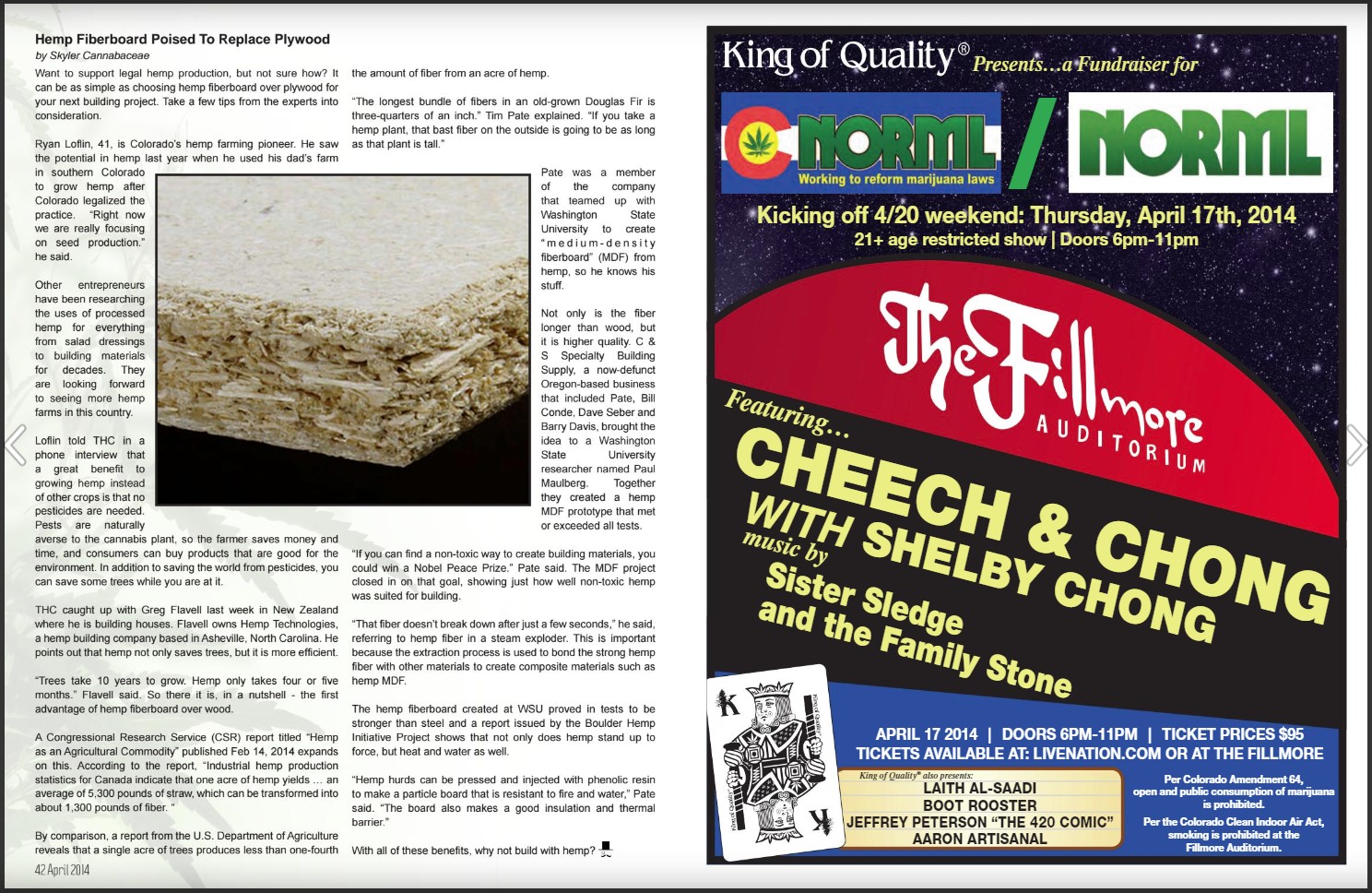
Hemp Fiberboard Poised To Replace Plywood

Want to support legal hemp production, but not sure how? It can be as simple as choosing hemp fiberboard over plywood for your next building project. Take a few tips from the experts into consideration.

Ryan Loflin, 41, is Colorado’s hemp farming pioneer. He saw the potential in hemp last year when he used his dad’s farm in southern Colorado to grow hemp after

Colorado legalized the practice. “Right now we are really focusing on seed production.” he said.

Other entrepreneurs have been researching the uses of processed hemp for everything from salad dressings to building materials for decades. They are looking forward to seeing more hemp farms in this country.

Loflin told THC in a phone interview that a great benefit to growing hemp instead of other crops is that no pesticides are needed. Pests are naturally averse to the cannabis plant, so the farmer saves money and time, and consumers can buy products that are good for the environment. In addition to saving the world from pesticides, you can save some trees while you are at it.

This article was originally published by The Hemp Connoisseur Magazine as Skyler Cannabaceae.
The Hemp Connoisseur, April 2014 – Issue #16

Mystery of Munchies Solved!

Fire up a joint, rip a few bong hits, or take a toke from a pipe or vaporizer. There is one consequence of these actions that cannabis users can count on.

The munchies.

What is it that sends our taste buds into overdrive?

A new study from the journal Nature Neuroscience claims that it is a heightened sense of smell that makes a person crave food after using cannabis.

Science has known for decades that the human body has an endocannabinoid system. Endocannabinoids are compounds that have the same effect in the body as the cannabinoids in cannabis, like THC and CBD, but the body produces them naturally.

When a person uses cannabis, the cannabinoids from the plant (called phytocannabinoids) bind with receptors all over the body to produce different effects. But why is hunger one of those effects?

Perhaps it’s because hunger enhances a person’s sensory perception. In ancient times, this sharpened us up so we could better hunt and gather food. It’s called survival.

According to the study conducted by European scientists led by Giovanni Marsicano of the University of Bordeaux, when cannabinoids are received by cannabinoid type-1 (CB1) receptors in the main olfactory bulb (MOB) of the brain, they signal that the body is starving.

Mice were used as test subjects. Since all mammals share cannabinoid similarities, the brains of mice and humans function quite alike.

Read More at the Hemp Connoisseur website.

or Read the article as displayed below at Issuu.com.

This article was originally published by The Hemp Connoisseur Magazine as Skyler Cannabaceae.

The Hemp Connoisseur, April 2014 – Issue #16

Strong support for medical cannabis in Iowa; No personal use, Quinnipiac Poll shows

A poll released by Quinnipiac University Monday indicates that voters in Iowa are strongly in favor of allowing medical cannabis use in their state when recommended by a doctor. Conducted from March 5-10, the university questioned 1,411 registered voters about whether they support or oppose allowing adults to use cannabis for medical purposes.

The survey found that an overwhelming 81% support medical cannabis. When broken down, the lowest level of support across party lines, genders and age groups was Republicans with 68% support. The highest approval comes from Democrats with 89% in favor; Independents were slightly lower at 82% support.

On the other hand, Iowans oppose allowing recreational use by adults. According to the poll, 55% oppose cannabis for personal use, while 41% think it should be allowed. Other questions show what Iowans think of The Great Cannabis Experiment in Colorado with a 54-28% saying that they think it has hurt Colorado’s national image.

(Source: Quinnipiac University)

Colorado NORML hosts comedy night, raises $4500 for the cause

Activism- Colorado

Last Wednesday, Colorado NORML held an event at ComedyWorks, a popular comedy club in downtown Denver. Headlining the night was popular cannabis comedian, Hippieman. Rachel K. Gillette, Executive Director of Colorado NORML, reports by email that there around 300 people came out and the group raised over $4,500.

Advertisement for Fundraiser

“The Comedy Event was great.” Gillette said. “The comedians were absolutely hilarious.” With cannabis and cannabis users being the butt of many good-natured, often self-directed jokes, Hippieman and other comedians had the crowd laughing all night and people walked away with some fun t-shirts and a couple of vaporizers as door prizes.

The organization’s next event will be a concert at the Fillmore Auditorium on Thursday, April 17. The headliners of the show have yet to be announced, but Gillette promises, “It will be BIG!”

Maryland senate votes to decriminalize, but state won’t legalize

The question of full legalization is off the table in Maryland for this election cycle with no such bills garnering enough votes to make it out of committee. Maryland has laws allowing cannabis for medical use and granting the ability to raise a medical necessity defense in court, but lawmakers are not ready to pull the trigger on recreational cannabis just yet.

On March 14, a bill proposing decriminalization passed easily in the Senate by a vote of 36-8. S.B. 364, which would remove criminal penalties for possession of less than 10 grams of cannabis, is now in the hands of the House Judiciary Committee. Similar legislation stalled in the same committee during the last legislative session.

California cannabis business wants CNN’s Gupta to report on more than just CBD

United Patients Group, a cannabis information source that bills itself as “a discreet, safe, and professional online medical cannabis information resource for prospective and current patients, caregivers, and medicinal cannabis industry professionals,” issued a statement today. In it, John Malanca, the company’s owner, said that while they are “thrilled about CNN and Dr. [Sanjay] Gupta’s hard work,” something was missing.

In the first CNN special “Weed“, which aired last August on CNN, the well-respected Gupta stated that he had changed his mind about marijuana not being a medicine. The broadcast told the story of Charlotte Figi, a 5-year-old girl with Dravet Syndrome whose condition was dramatically improved by ingesting cannabis extractions high in cannabidiol (CBD), one of most prevalent cannabinoids in cannabis.

This past Tuesday, Gupta hosted “Weed 2: Cannabis Madness“, the follow-up featuring a family from New Jersey, likewise with a child who had intractable seizures, who traveled to Colorado to visit the Stanley Brothers and Realm of Caring for high-CBD extractions that could help their child.The specials are seen by some medical cannabis advocates as downplaying the importance of THC, the psychoactive compound in cannabis that makes you feel high. Malanca wants people to remember that cannabis isn’t just about CBD and seizures.

“Let’s not forget that cannabis treats many other serious ailments, including cancer.” Malanca founded United Patients Group after his father-in-law was diagnosed with Stage 4 lung cancer in 2010. Cannabis (not CBD-only) was used to treat the cancer and today, 80-year-old Dr. Stan Rutner is alive and cancer-free.

What do you think of CNN’s almost THC-free coverage?