20ish Questions with Gary Johnson

Gary Johnson, former two-term governor of New Mexico and 2012 presidential candidate, is adding another position to his resume: Cannabis Mogul.

Cannabis Sativa, Inc. appointed Johnson as its new President and CEO on June 30. The Nevada-based company plans to sell cannabis-infused lozenges designed by activist Steve Kubby. Kubby joined Cannabis Sativa as its Chairman of the Board at the same time as Johnson’s move. The deal that led to the new management included Cannabis Sativa buying Kubby’s company KUSH and the related patents and research.

Publicly traded stock in Cannabis Sativa has jumped from $4.00 per share before the leadership change was announced on June 30 to $10 per share as of end of business, August 18. Johnson agreed to the job with a salary of $1/year, but received stock in the new company. So far, that deal looks to be paying off for Johnson.

THC interviewed the former governor by phone on July 17. He told us about the new company, how the cannabis industry is changing the world for the better and peaceful civil disobedience as a means for change.

This article was originally published by The Hemp Connoisseur Magazine.
The Hemp Connoisseur, September 2014 – Issue #21

Princeton University suspended employee for using medical marijuana

Don DeZarn, 48, has worked for Princeton University for 18 years. Before that, he worked for the U.S. Army and Navy, where he acquired Post Traumatic Stress Disorder (PTSD) for which medical marijuana is a recognized treatment. Last week, DeZarn was given an ultimatum by his employer: stop participating in NJ’s medical marijuana program or forfeit his job.

As of yesterday morning, DeZarn, a senior operations manager for the campus’ dining department, says he is suspended with pay. He informed his “supervisors, employee health and human resources representatives” about his marijuana usage. When he advised Public Safety, however, they informed him that there would need to be an investigation. DeZarn went into work on Monday as normal, but says Human Resources told him that he is suspended with pay and then escorted him to his vehicle.

“All I have ever asked for from the University is to be allowed to take my physician prescribed medication just like any other employee.” DeZarn told Marijuana.com Monday morning. “I am absolutely NOT interested in any way in seeking any type of legal damages from the University. I do not have an attorney and at this point do not intend to retain one. I just keep hoping this is a bad nightmare and I will wake up and everything will be OK.”

DeZarn comes prepared to fight for his marijuana rights. He’s a long-time marijuana activist, campaigning for office in New Jersey on a legalization platform and even being arrested twice for civil disobedience, though he sticks to the law with his medical use. When New Jersey approved his usage of marijuana under the state’s Compassionate Use Act, DeZarn had to ask a judge for further permission, since drug use would violate his probation. It turns out that Princeton is more restrictive than probation.

DeZarn says that when he was approved for the use of medical marijuana in May, he stopped taking his prescription medications in consultation with his physician. His physician prescribed the high-CBD strain and “assured me I would not be impaired while medicating.”

Even though the strain that DeZarn uses is low in THC, the main hallucinogenic in marijuana, Princeton’s Vice President for Human Resources, Lianne Sullivan-Crowley, has made the University’s position clear.

The law seems to support an employer’s right to maintain a drug-free workplace, including prohibiting the use of marijuana during work hours as well as working while under the influence of marijuana,” Sullivan-Crowley said. [NJ.com]

DeZarn got support from local media and activists over the weekend whom he thanked on his Facebook page. He also updated friends on his plan going forward as of last night.

After seeing the outpouring of support, I have decided that I will return to work at my regular position tomorrow morning and will conduct myself just like any other university employee. When it becomes necessary for me to medicate with a medicine prescribed to me by my licensed physician I will do just that.

I will deal with the consequences, whatever they might be. All I have ever asked for is to be treated just like any other employee. We shall see what tomorrow brings.

It is unclear whether his post had anything to do with today’s suspension or if the suspension was already planned.

Unfortunately, this type of problem is likely to continue with only 8 of the 34 medical marijuana states including protections from discrimination not only in employment, but housing and child custody. A report published by Americans for Safe Access in July explains the employment discrimination issue:

An individual’s status as a medical cannabis patient or a positive test for cannabis metabolites should not be an employer’s sole basis for either a refusal to hire or dismissal of that person. Because of their regular cannabis use, most patients will test positive without being impaired. Medical cannabis use should be treated like any other prescription medication under state law. While some states have explicit protections, many laws are inadequate to provide the necessary safeguards against employment discrimination. [Medical Marijuana Access in the U.S.]

According to the report, if you want job security and medical marijuana at the same time, Arizona, Connecticut, Delaware, Illinois, Maine, Minnesota, New York and Rhode Island have you covered.

New Jersey? Not so much.

This article was originally published by Marijuana.com.

The Secret Cup and marijuana in New England

“The city was amazing, it was my first time really experiencing the East Coast and I really loved it.” says Jeremy Norrie. “The people seemed pretty conservative but very liberal with their social values and were easy going for the most part.”

The city Norrie is talking about is Providence, Rhode Island, where he helped organize and execute the first East Coast marijuana concentrates competition. Known as “The Secret Cup: Beast Coast,” the event mirrored similar competitions that have been happening in Colorado and the West Coast for several years now.

“Are you excited to be covering a historic event?” Excited residents of Rhode Island, New Hampshire, Massachusetts and even Maine asked this question on learning I was covering the event. I explained that I had covered the first day of recreational sales in Colorado as well as the numerous events in Denver last Easter weekend. Still, it was an important moment and one that signifies the turning of America’s tide–even on the East Coast.

Marijuana culture isn’t the same on the East Coast. While many revelers at events in Denver wear marijuana-themed shirts from dispensaries or cannabis companies, the traditional tie-dye was still pervasive in Rhode Island. With dispensaries either keeping a low profile to avoid police or DEA targeting, these figures have less incentive to advertise.

“What number do you want?” asked a pretty girl named Kait at the dab bar, an area for judges, VIPs and qualifying medical patients. There were 30 entries in the competition for connoisseurs and new consumers to enjoy. While the names were kept confidential for fair voting, attendees discussed their favorite numbers and suggested others to friends.

“There was a decent mix of solventless, budder and shatter.” says Norrie. Extraction artists use butane to made the shatter and budder. Solventless is often called water, or bubble, hash as it does not use a chemical solvent to extract. So how do consumers decide their favorite?

On the East Coast, you often take what you can get for concentrates and flower, but as marijuana legalization expands, the culture grows. It’s important for consumers to learn to be discerning.

“What separates the good from the bad with buying concentrates is most importantly the overall appearance (coloration, cleanliness, texture) and the scent profile.” says Bobby Nuggz, an organizer for the RI Secret Cup and Connoisseur’s Choice Award winner at last December’s Secret Cup National Finals in Denver. “If it looks clean with beautiful colors, no visible fibers and smells very attractive you will be in for a treat.”

The culture exists in a legal gray area due to restrictive laws in the more populated states. Lawmakers only recently made medical marijuana legal in Massachusetts, Connecticut and New Hampshire—2012 for MA and CT and 2013 for NH. Regulations and framework for practical needs, like dispensaries, slowly materialize.

The Cup’s host state, Rhode Island, passed MMJ laws in 2006. Their allowance for reciprocity for out-of-state MMJ patients and decriminalization for adult use allowed most attendees legally consume. According to Norrie, the marijuana enthusiasm is alive and well in New England.

“This was our second most popular show we have ever done, it was bigger than both shows we’ve done in Seattle and bigger than all of the shows we’ve done in Colorado.

“There is going to be a huge scene on the East, and it’s only beginning.”


Here are the winners from “The Secret Cup: Beast Coast”:

High CBD – Coastal Concentrates #15 Meltdown x Tangie Shatter

High THC – Anchor Extracts – #10 East Coast Pure Kush Shatter

Best Budder – East Coast La Nostra Family – #3 Tennessee hawgsbreath x chem #4 Budder

Best Non Solvent – High Grade Extracts – #16 Jack the Ripper Fullmelt

Connoisseur’s Choice – #6 cannaissuer extracts – Cataract Kush x Jesus OG x Real Sour Diesel x Hemlock Full Melt

First Overall – Rhode Island Red Extractions – #9 Orange Tangerine Kush Shatter

Second Overall – Something Better Concentrate Company #14 – Mother of Shatter

Third Overall – Diesel Extracts – #13 L.S.D x Medflight Shatter

This article was originally published by Marijuana.com.

A perfect storm of green for Gary Johnson

Politicians are supposed to fight for the values of their constituents. They follow those values to win elections and stay in office. However, it’s their actions after they leave office that often shed light on their true interests.

In the case of Gary Johnson, former two-term Governor of New Mexico and the 2012 Libertarian Party candidate for president, the public is now finding out how serious he was (and is) about cannabis legalization.

On June 30, Cannabis Sativa, Inc., a Nevada-based medical cannabis company with national plans, named Johnson as President and CEO. The ripple through both the cannabis world and mainstream media resulted not only in increased coverage, but also a marked increase in the company’s value per share.

If you want to jump feet first into the cannabis market, this is the way to do it.
The company and Mr. Johnson have both highlighted that his salary will only be $1; pointing out as an aside that he has an equity stake in the company. That equity stake came in the form of 509,558 shares of stock in the publicly traded Cannabis Sativa, Inc. When the company issued the stock, it was worth roughly $2 million, or $4 per share, and a 3.4% ownership of the company.

Why count on Johnson to grow the company and his interest in the process? He has a good record of accomplishment.

“I did start a one-man handyman business in Albuquerque in 1974 and I actually grew that business to over a thousand employees.” Johnson said in a phone interview, indicating his business acumen that has served him well in life.

Johnson says marijuana was a part of growing up for him, “as it was tens of millions of people,” This in response to a question about what first got him involved with cannabis. “I just found it to be such a better alternative than alcohol.”

The former governor started using cannabis at age 17 by his own account. In high school, he was a competitive athlete and says he really didn’t experience any negative side effects from his cannabis use. Johnson even boasts that he’s still a competitive athlete at age 61 and though he prefers not to smoke flower, he continues to use cannabis products.

Johnson admittedly sees his involvement in the cannabis industry as taking advantage of the opportunity available from the spread of cannabis legalization and acceptance in America. “An opportunity that’s changed the world for the better; medically and recreationally both.” He’s not the only well-known figure to join Cannabis Sativa on June 30.

At the same time, renowned cannabis activist, Steven Kubby, sold his development company. Kush, as Kubby’s company is known, is now a wholly-owned subsidiary of the larger Cannabis Sativa. With the buy-out came the stockholders of Kush, including Kubby and Johnson as Directors. Johnson signed on with Kubby and Kush in February 2014.

The merger deal resulted in David Tobias, 62, stepping down as President and CEO of the new company to make way for Johnson. David’s brother Barry Tobias, 72, was a Director of the old company and remains a Director of the new one. According to SEC filings, the Tobias brothers maintain a combined 43.1% interest in Cannabis Sativa, Inc. As of July 28, the market valued the company’s stock at $8.10 per share.

It’s unclear whether we can attribute the stock’s meteoric rise to its future prospects, but for now, at least, the market seems to approve of the Kush acquisition and the new Chairman and CEO of Cannabis Sativa. However, the framework of Kush and two new leaders were not the only assets purchased by the company.

Also at stake were intellectual property rights to Kubby’s propriety cannabis strain, known as “NZT”, which he claims to be much more potent and medically beneficial than other strains. With the strain came Kubby’s method of extracting necessary cannabinoids from the plant to create a lozenge delivery system and methods for concentration into a topical ointment.

After the announcement, shares of Cannabis Sativa began a quick gain of 6.14 points to a high of $10.14 per share on July 9. With the now $8.10 per share, Johnson has doubled his investment in under a month. Of course, the deal has been in the works since before Johnson signed onto Kush as a Director: Cannabis Sativa announce their planned joint venture with Kubby’s Kush at the beginning of the year, with an option to purchase the company outright.

It’s difficult to tell if the price jump is related to the closing of the deal or Johnson’s high-profile confidence in its success.

“You mix the CBD lozenge with THC and all of a sudden, man, you’ve got direct competition to all of the prescription painkillers,” Johnson says. He then points out the epidemic of opiate and prescription drug abuse that racks up a large body count nationwide each year–while cannabis has never has a reported death as a direct result.

On July 15, Johnson added to his resume when he became an Advisory Board Member for Medical Cannabis Payment Solutions, a company focused on providing dispensaries and other related cannabis industry sellers with methods to normalize the sale of cannabis. While compensation was not an issue, normalizing sales to conform to national standards will certainly help Cannabis Sativa and all of its owners.

We asked Johnson about other issues that marijuana faces, which might hinder the plant’s growth in America.

“The issues, I think, start with impairment.” Johnson told us. “The levels of impairment that have been established under marijuana are absolutely in no way, shape or form impairment. There’s simply a test to determine presence in your blood stream, so that’s a big issue that needs to get addressed.”

With wise words like that in an America that believes in marijuana, could Johnson be planning to exit the company and enter the 2016 U.S. presidential race?

It’s not so farfetched: Johnson’s employment contract with Cannabis Sativa states that he will serve in his current position, barring unforeseen circumstances, until May 31, 2015, after which time the company has the option to extend his contract on a yearly basis.

However, citing the major life changes that occur when you officially become a candidate, Johnson could not confirm that he’ll run for office again. But if he does decide to run–in 2016 or 2020–you’d imagine that he’d have the cannabis contingency on his side.

And the future of legalization as Johnson sees it?

“I really firmly believe that in 10 years most of the states will legalize pot.” Johnson concludes.

Step aside, ganjapreneurs. Welcome to the world of high-profile cannabis capitalism.

This article was originally published by Marijuana.com.

Marc Emery returns home to Canada following deportation from U.S.

International cannabis activist Marc Emery returned to his home country of Canada Tuesday after spending nearly five weeks in a Louisiana detention center following completion of his U.S. prison sentence.

As we reported in July, Emery received a five-year sentence after pleading guilty to selling cannabis seeds to U.S. customers. After his release, he was held at Tensas Parish Detention Center awaiting deportation to Canada. Yesterday, Emery was taken to Detroit and allowed to cross the border in Windsor, Ontario.

Emery pleaded guilty to selling cannabis seeds from Canada to U.S. customers by mail in Seattle, WA in 2010. While he was serving his sentence, Washington state legalized retail cannabis sales in 2012 with the passage of Initiative 502. Ironically, sales began on July 9 of this year, the same day Emery’s sentence ended with time off for good behavior.

Jodie Emery, Marc’s wife and business partner, hugged her husband after he walked out of custody. Supporters have been wearing “Free Marc Emery” t-shirts since his arrest and they chanted, “Marc is free” in satisfaction as he set foot back on Canadian soil.

Emery wasted no time getting back to his brand of fire-breathing activism holding a press conference for Canadian news outlets and attacking Steven Harper’s Conservative government. Opining on the state of Canada since he was last free, he wondered aloud how the country got so many “cowardly, gutless” politicians who refused to address important issues. He also defended his position on cannabis.

“It’s not about getting high. It’s about correcting a major injustice that’s gone on for half a century.” Marc said of his cannabis legalization advocacy.

In addition to his goal of legalizing cannabis in Canada in the next election cycle, Emery pointed out Canada’s budget deficit as a future issue he plans to help solve. Marc and Jodie are beginning a 30-city tour in September stumping in support of the Liberal government of Justin Trudeau. Though the federal Liberal Party has disavowed them, Trudeau supports cannabis legalization, which is enough for the Emerys. Marc made no secret about how he feels about the opposition.

“I deplore and loathe Steven Harper,” Marc said calling Canada’s Prime Minister a “Machiavellian manipulator.”

Emery will be returning home to Vancouver, British Columbia on Sunday and supporters have planned a welcome home rally. He will be meeting supporters and celebrating his freedom in Victory Square at noon PST.

This article was originally published by Marijuana.com.

Denver’s first legal county fair, “Pot Pavilion” ends in THC-overdoses, lawsuit

Just because cannabis is now legal doesn’t mean it needs to be everywhere.

This past weekend, Denver held its annual county fair. For the first year, and possibly the last, the fair had a “Pot Pavilion”.

Judges awarded blue ribbons in categories such as Best Marijuana Plant and Best Hash. But despite that off-site consumption and the infusion of marijuana into the event’s ethos (and marketing play), the fair clearly stated that they strictly prohibited cannabis at the event. Photos of the entries were supposed to function as the only event collateral and were to represent competitor offerings (in spirit).

Unfortunately, some cannabis slipped into the fair and made a mess.

Three fair-goers reportedly ended up sick from an overdose of THC, the primary psychoactive component of cannabis. The individuals, according to media reports, weren’t expecting to get high that day: they just wanted a chocolate bars that were handed out by LivWell, a cannabis dispensary chain in Colorado. The dispensary has nine locations including four in the Denver area and three in Colorado Springs. The licenses for those operations are now in jeopardy, pending investigation.

“They told us there was nothing in them. They were free samples anyone could have grabbed. I asked the vendor twice and they told me no there’s nothing in them,” Kari Mitchell, one of the people sickened, told FOX31 Denver.

LivWell released the following statement in response to the event:

“We are aware that someone made a complaint to 7NEWS alleging that chocolate samples distributed at the Denver County Fair contained cannabis.  If this occurred it was without our knowledge and was not sanctioned by our company.  We are currently investigating the matter.”

The Marijuana Enforcement Division (MED) is investigating the incident and LivWell, while denying blame, offered to cover the medical expenses of the two people who ended up in the ER. Still, LivWell and other vendors at the Pot Pavilion could have easily avoided the situation and the ensuing black eye on the industry and the movement by keeping cannabis the way it always has been: private.

Just because cannabis is now legal doesn’t mean it needs to be everywhere. The County Fair is not the place for cannabis. Family events of any kind are not a place for cannabis. Coloradoans fought for and won their right to use cannabis, but that right comes with a responsibility. The world is watching. When people and companies don’t live up to this responsibility, we all look bad.

Family at Denver County Fair

This article was originally published by Marijuana.com.

What to tell children about cannabis

We recently published an article that sought to answer the question, “What Message Does Legalization Really Send to Children?” Jodie Emery, Tommy Chong and Gary Johnson were kind enough to give us some answers from their points of view. The next logical question was, “What message should we, as cannabis users, be sending to children?”

The cannabis community, a phrase I usually associate with an activist vibe, must act sensitively regarding the possibility of children being exposed to cannabis. However, what is a parent who needs cannabis for medical use or even for stress to do? Just like drinking alcohol now and then doesn’t make a person a bad parent, so too, parents who use cannabis, for whatever reason, are not automatically bad (though the media tends to go after the stereotype).

Originally, this article was intended to have five different experts provide answers to this question. But one response from Lieutenant Commander Diane Goldstein, who began her career as a Patrol Officer for the Redondo Beach Police Department in 1983, and now works for Law Enforcement Against Prohibition (LEAP) floored us.

Goldstein retired as a Lieutenant Commander after 20 years of service in 2004. Her experiences on the job and a brother who ended up a victim of the Drug War led her to join LEAP, a group that she serves as a board member. She calls drug prohibition in America “fiscally unsound and fundamentally unjust.”

Lieutenant Commander Goldstein’s response was so personal and well written that I couldn’t bring myself to break it up into quoted snippets. Most importantly to me, personally, is that a former law enforcement officer goes far beyond, “Just Say No.” The following is her response in its entirety:

The last few years of marijuana activism has created a new normal. The acceptance of marijuana as efficacious medicine as well as the emerging adult consumption market will force us as parents to have age-appropriate discussions with our children surrounding the issue and access to marijuana.

Clearly, the groundwork for discussion needs to start when they are young. As a parent and now a grandparent, I know that from the moment our children are born that we are creating an environment that reduces the harms to them as they explore their world. As a mom, my discussions with my son started as a toddler in teaching him that there were things that adults can do that children can’t.
I used this concept and the strategy of “harm reduction” to help him assess risks when making decisions. This concept applied to everything from engaging in premarital sex, drugs, alcohol, fights, driving, and tobacco use. The parenting list is endless on what can endanger our children if they don’t have critical and credible information. Clearly I don’t promote or condone drug and alcohol use or abuse for our children, but we have an obligation as good parents to promote open, honest and effective communication to ensure that not just our kids are safe but everyone’s.

What we tell our children is dependent on their age. As a parent, you will bear more responsibility when they are younger. If you are either a patient or consumer, ensure that your marijuana is secured in a child-proof container and that your child is unable to access this container.

But it’s not just simply locking up your marijuana it is also starting to have a lifelong discussion surrounding the benefits and harms of not just marijuana, but all drugs. I suggest that every parent read the Drug Policy Alliance “Safety First” pamphlet that introduces a reality based approach to discussing and reducing the harms of drugs.

But here are a few of my own:

  • As a parent remember that it’s not just your words but your actions. Model responsible behavior and your children will do so as well.
  • Remember that there are things that adults do that are legal that are not age-appropriate for our children.
  • If you don’t talk honestly with your children there will be an information vacuum filled by a peer or someone else that may not have your child’s best interest at heart.
  • Understand the difference between substance use and misuse.
  • Have a safety plan so your child knows that if they are intoxicated or with a friend that is intoxicated that they can call you no questions asked.
  • Never encourage or allow your children to drive while under the influence of an intoxicant or to drive with a friend that is under the influence.
  • [T]here are still harms associated with [marijuana]’s use if our children start experimenting with marijuana, alcohol, tobacco or any other drug at a young age. These harms include the collateral consequences of a drug conviction that can alter the course of a child’s life.

Lieutenant Commander Diane Goldstein (Ret.), board member of Law Enforcement Against Prohibition, a group of law enforcement officials opposed to the war on drugs.

This article was originally published by Marijuana.com.

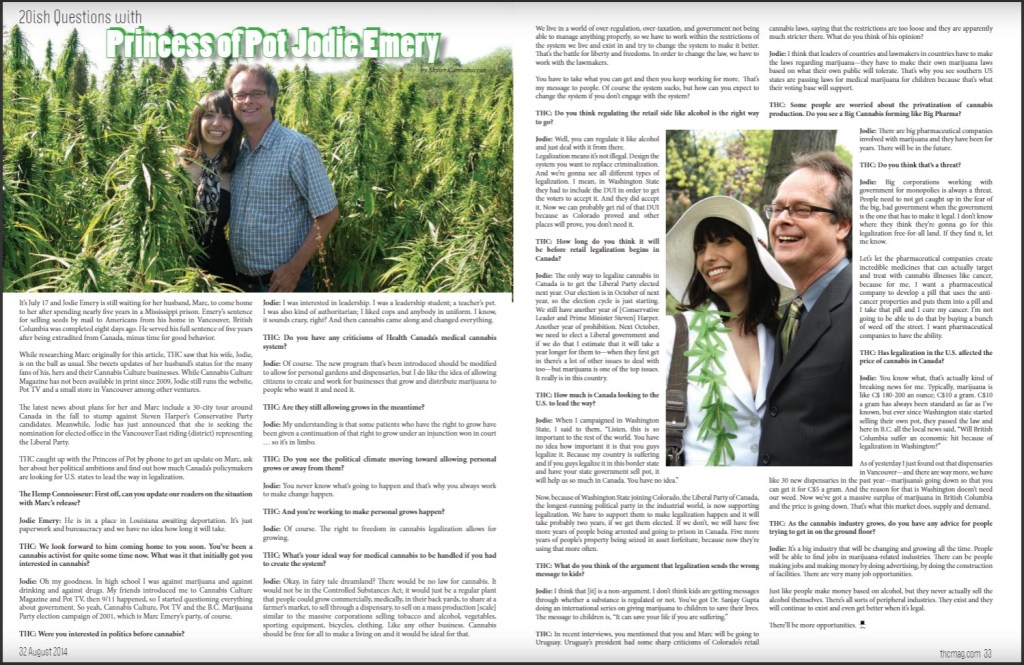
20ish Questions with Princess of Pot Jodie Emery

It’s July 17 and Jodie Emery is still waiting for her husband, Marc, to come home to her after spending nearly five years in a Mississippi prison. Emery’s sentence for selling seeds by mail to Americans from his home in Vancouver, British Columbia was completed eight days ago. He served his full sentence of five years after being extradited from Canada, minus time for good behavior.

While researching Marc originally for this article, THC saw that his wife, Jodie, is on the ball as usual. She tweets updates of her husband’s status for the many fans of his, hers and their Cannabis Culture businesses. While Cannabis Culture Magazine has not been available in print since 2009, Jodie still runs the website, Pot TV and a small store in Vancouver among other ventures.

The latest news about plans for her and Marc include a 30-city tour around Canada in the fall to stump against Steven Harper’s Conservative Party candidates. Meanwhile, Jodie has just announced that she is seeking the nomination for elected office in the Vancouver East riding (district) representing the Liberal Party.

THC caught up with the Princess of Pot by phone to get an update on Marc, ask her about her political ambitions and find out how much Canada’s policymakers are looking for U.S. states to lead the way in legalization.

This article was originally published by The Hemp Connoisseur Magazine as Skyler Cannabaceae.
The Hemp Connoisseur, August 2014 – Issue #20

What message does legalization really send to children?

We let three celebrity cannabis activists answer for us…

“I went on my back balcony to smoke a blunt.” says Lex Bryant, 26, an auto mechanic who moved from Virginia to Colorado last year. “I fired it up and I was sitting there, chilling. There’s a balcony above me and two kids came out on the balcony. They were playing. They’re probably somewhere between six and ten. They were out there talking and I was just smoking, minding my own business.“

“Do you smell that?” said the older boy to the younger.

“Yeah, I do.”

“That smells like some weed.  I can’t wait until I’m older and I get to smoke some.”

“They said, ‘I think that man down there is smoking a blunt.’ That kinda put me on the spot. I felt a little uncomfortable, so I went back inside.”

After he went inside, Bryant posted a status update on Facebook expressing his ambivalence about the situation.

“What about the kids?” The question serves as a rallying cry for those who fear change. In recent interviews with three well-known cannabis activists, we asked them to answer the often-rhetorical question.

“I’ve got five kids and three grandchildren.” says comedian and NORML Advisory Board member Tommy Chong.

“I wouldn’t let my kids smoke cigarettes. I discouraged it and I wouldn’t let them drink and drive. I discouraged their alcohol use, although, they all went through that phase. I encouraged their cannabis use.”

Justifying his parenting decisions in hindsight, Chong says, “I look at what happened to the little kids with epilepsy and how cannabis reduces their number of [seizures]from a lot to practically none.”

“I really believe that cannabis is a medicine for all ages.”

Jodie Emery, owner of Cannabis Culture and related business with her husband, Marc, answers the question with derision, “I think that argument is a non-argument. I don’t think kids are getting messages through whether a substance is regulated or not.”

Emery says that legalization doesn’t send the wrong message and points out the right messages being received.

“You’ve got Dr. Sanjay Gupta doing an international series on giving marijuana to children to save their lives. The message has moved beyond what about the children because one of the top doctors in America is doing showing about giving marijuana to children to save their lives.”

The message to children is, “It can save your life if you are suffering.”

Gary Johnson fought for legalization while he governed New Mexico for eight years and recently entered the legal cannabis industry.

“Well, it’s actually the opposite.” Johnson says of the alleged threat to minors.

“They come out and they try to sting all these operations in Colorado, the fact that underage sales are taking place.” Referring to recently reported results of a sting operation with police trying to get dispensaries to sell to minors. “They can’t find it. It’s not happening.”

Johnson concedes that minors still do get their hands on cannabis by other means, but sees that as a reason to end Prohibition, not continue.

“In a legalized environment, at least you know what it is that you’re consuming and if you’re consuming within the guidelines, and there needs to be responsible labeling that goes along with all this stuff.”

While this article is not an endorsement by the author or Marijuana.com for minors using cannabis freely, we tire of this specious rhetorical question used to raise fears among parents. The real question is one of relative harm.

“The biggest fear that [cannabis]presents to any kids is that it’s prohibited.” Johnson concludes.

What message do you think legalization sends to children? Do you think schools should educate our youth about the benefits and detriments of cannabis? 

This article was originally published by Marijuana.com.

Canada’s Freedom Fighters: The plight of Marc and Jodie Emery

On July 9, Marc Emery was released from the Yazoo City Prison in Mississippi. Marc has since remained in a detention center waiting his release to Canada.

“You don’t give up and say, ‘Oh, they’re corrupt and this sucks. I’m not working with them.’” Says Jodie Emery.

“You say, ‘Okay. We took that loss. Now it’s our turn.’ And you take another chance, and you fight for more freedom and every little chance that you can get, you take a little bit and then you ask for more.”

Jodie knows plenty about fighting. For over five years, Canadian and American cannabis activists have been wearing shirts that say “Free Marc Emery”, her husband and publisher of Cannabis Culture magazine before it ended its print run in 2009. After he was caught selling cannabis seeds to Americans in violation of American law, the Canadian government allowed Marc to be extradited to the U.S. for trial.

Facing stiff penalties, Marc took a deal, pleading to his so-called crime and receiving a 5-year prison sentence in exchange. As of July 9, Marc served his full sentence, minus nearly eight months for good behavior. Yazoo City Prison in Mississippi released Marc into the custody of a Louisiana detention center while he awaits deportation to Canada.

When we spoke with Jodie, who also just became the new Liberal Party candidate for the Canadian Vancouver East Riding nomination, Marc was still being held in a Louisiana detention center with no definitive expectation as to when he would be returned to Canada.
“He’s doing as well as he can.” Jodie told us in her normal upbeat tone during a July 17 phone interview.

Far from silencing Marc by locking him up, his time is prison seems to have made both he and Jodie even more vocal. Jodie took over Cannabis Culture and has been seen regularly as a guest on Canadian news shows. In the meantime, Marc has been blogging from his prison cell and planning a tour to take down Canada’s Conservative government in favor of Justin Trudeau’s Liberal Party. Trudeau embraced the cause of legalization as part of the national party’s platform.

A check of the U.S. Immigration and Customs Enforcement confirms that Marc is “In Custody” as of July 22. Records show that Tensas Parish Detention Center in Louisiana is holding him, though no indication is given as to when he will be released to Canada. Jodie says that they still have not provided any timetable for release.

Jodie, a previous candidate for office backed by the Green Party, told us that one of her criticisms against the way Canada’s medical cannabis system is set up is that it precludes personal grows. A March 21 court-ordered injunction is preventing the Conservative government from doing away with personal cannabis gardens already in existence, but there are still no provisions for them in the law.

“You never know what’s going to happen and that’s why you always work to make change happen,” was Jodie’s cheery response to the question of whether she thinks Canada is moving toward allowing for personal grows.

When a standing treaty allowed Marc, as a Canadian citizen, to serve out his sentence in Canada, the Conservative Harper government refused to bring him home. Seemingly playing against a stacked deck, Jodie did not take a cynical view of government. Instead, it made her fight even harder.

“I’m going to carry the Green ideas into the Liberal party,” Jodie says.

While some Green supporters are disappointed in her switch, pundits in her new party are picking up the scent of trouble (or is that cannabis?) Die hard liberals fear that her presence in the race will actually hurt Liberal leader Justin Trudeau by giving Conservatives an easy target in his party.

“Well, that’s fine,” Jodie says in response to a federal Liberal Party spokesman disavowing any connection between the Party and the Emerys. “[T]he federal Liberal party has not reached out to me and I have not reached out to them. Marc has not reached out to them and they have not reached out to Marc. I joined the party at the request of Vancouver East Liberal Party Riding Association members who are also young liberals who helped develop the marijuana legalization policy that’s now part of the platform.”

If Vancouver voters elect Jodie, they might find her apt to compromise on the issue of moving legalization forward. Her stated message is that all legalization steps are good and advocates should celebrate the small victories like CBD-only laws, but keep fighting.
“[There are] 23 medical states, 17 decrim states and 2 legal states. None of that would have happened if the activists in California demanded that the state government sell marijuana and it’s that or nothing.”

After Marc returns to Canada, the Emerys have a 30-city tour planned in the fall. They will stop at each spot to show their support for the Liberal Party edging out the controlling Conservative Party in the October 2015 parliamentary elections.
Jodie says that she will be part of the tour whether she wins the nomination or not. She points out that she is not a “one issue candidate” as some critics have claimed.

“Marijuana legalization is definitely what I’m most recognized for but most people [also]know I’m about open, accountable government, tax spending reform, justice and policing and spying and prisons.” She also highlights the environment as an important issue for her.

Asked about how long it will be before Canada begins to legalize retail cannabis, Jodie pointed out that the Canadian provinces cannot create their own cannabis laws the way that U.S. states do. Cannabis laws need to be changed on the federal level.

“The only way we’re going to have that happen is to elect the Liberal government. The Justin Trudeau Liberal Party.” Jodie says that if the Liberal Party takes over in 2015, she expects legalization to begin one year later. She notes that it will take that long for the new party to get settled. And if the Conservatives hold onto power?

“[W]e will have 5 more years of people being arrested and going to prison in Canada.”

This article was originally published by Marijuana.com.